Architecture

Zaha Hadid Architects Shapes a Fluid Landmark on the Shores of Okinawa

Zaha Hadid Architects has unveiled a hotel concept that redefines coastal hospitality in Japan.

Por: Rubén Carrillo
The Vertex Hotel is positioned between a dense subtropical forest and the open sea / Photo Zaha Hadid Architects

The Vertex Hotel is positioned between a dense subtropical forest and the open sea. This location demanded sensitivity, precision, and deep environmental awareness.

The project was commissioned by the innovative hospitality brand Not A Hotel. Rather than imposing on the landscape, the design moves with it.

The studio responded with a structure that flows like geology shaped by time. Every curve echoes the natural contours of the site.

A Form Inspired by Limestone and Shorelines

The Vertex Hotel takes its distinctive form from Okinawa’s limestone terrain. Its snaking silhouette mirrors the irregular edges of the coastline.

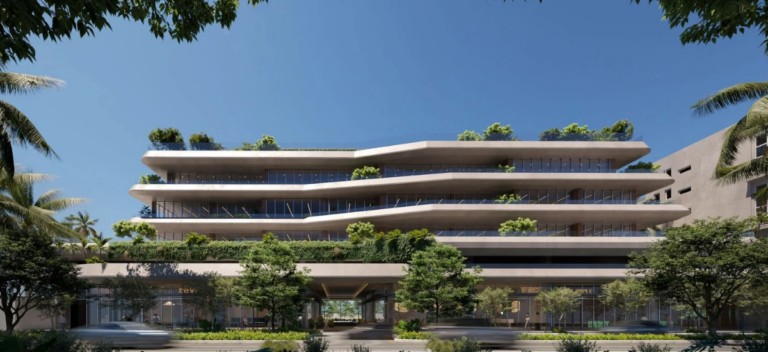
Instead of vertical dominance, the building spreads horizontally. Terraces step gently toward the beach.

Gardens, courtyards, and open walkways are woven throughout the structure. These spaces blur the boundary between architecture and landscape.

Zaha Hadid Architects describes the hotel as an extension of existing rock formations. The design appears carved rather than constructed.

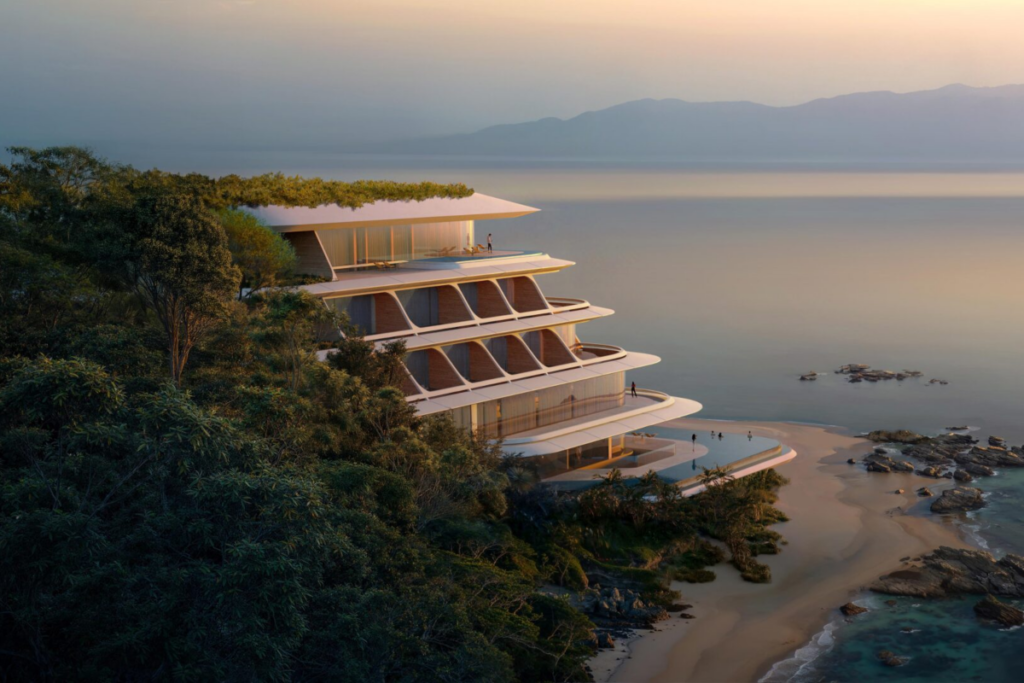
The Vertex Hotel takes its distinctive form from Okinawa’s limestone terrain. Its snaking silhouette mirrors the irregular edges of the coastline / Photo Zaha Hadid Architects

Sustainable Design at the Core

Environmental preservation guided every architectural decision. Local authorities provided strict ecological guidelines. The project aligns carefully with those environmental frameworks.

The Vertex Hotel is elevated above the shoreline. All facilities sit at least 6.5 meters (almost 22 ft)  above the high-water line. 

This strategy protects the structure from extreme coastal weather. It also safeguards fragile marine ecosystems below.

A modular construction system will be used. Prefabricated components reduce on-site disruption. This approach minimizes environmental impact during assembly.

Materiality Rooted in Place

Material choices reinforce the hotel’s connection to Okinawa. Locally sourced pine and limestone define much of the structure. These materials visually anchor the building within its surroundings.

Prefabricated concrete elements feature subtle textures. Their tones are designed to reflect nearby white sand beaches.

The result is a soft, cohesive palette. Nothing feels foreign or forced.

According to the studio, craftsmanship remains central. The design honors Okinawa’s architectural heritage. Traditional building principles are reinterpreted through advanced engineering.

Prefabricated concrete elements feature subtle textures. Their tones are designed to reflect nearby white sand beaches / Photo Zaha Hadid Architects

Spaces Designed for Light and Air

Natural ventilation plays a critical role throughout the Vertex Hotel. Communal areas are open and breathable. Villas and suites benefit from cross-ventilation. 

Soft-edged floor plates extend outward toward the horizon. At ground level, a slim outdoor pool wraps the structure.

Curved canopies trace the building’s perimeter. They create shaded outdoor spaces facing the sea. These elements reference the deep eaves of Okinawan vernacular architecture.

Solar Intelligence and Bespoke Canopies

Each canopy is uniquely shaped. Their forms were determined through solar irradiation analysis. This ensures optimal shade throughout the day.

The canopies guide guests from rainforest to shoreline. Views remain open and unobstructed. The transition feels natural and immersive.

According to project director Ludovico Lombardi, the experience is intentional.

The architecture strengthens the connection between guests and the environment. Nature is never framed as distant scenery.

Natural ventilation plays a critical role throughout the Vertex Hotel. Communal areas are open and breathable. Villas and suites benefit from cross-ventilation / Photo Zaha Hadid Architects

Questions and Brief Answers

RELATED POSTS

Receive the latest news

Subscribe To Our Magazine

Luster Magazine

Digital Magazine

Ingresa los siguientes datos y comienza a disfrutar de nuestra revista digital.