Culture

“Aún es de Noche en Caracas”: A portrait of Venezuela’s past decades

“Aún es de Noche en Caracas” (“It’s still night in Caracas”), a film produced by Edgar Ramirez, explores survival and resistance in Venezuela, mirroring social collapse and identity loss under an oppressive regime.

Por: Karla Sofía Espinoza
EDGAR RAMIREZ AUN ES DE NOCHE EN CARACAS
Directed by Mariana Rondón and Marité Ugás, and produced by Edgar Ramírez, Aún es de noche en Caracas is an intimate, harrowing portrait of Venezuela’s unraveling over the past decades / Photo by @johnnycarrano through IG @edgarramirez25

In the realm of contemporary cinema, few films capture the essence of a humanitarian crisis with the intensity and narrative of “Aún es de Noche en Caracas” (“It’s still night in Caracas”).

Directed by the acclaimed Mariana Rondón and Marité Ugás, and produced by the charismatic Edgar Ramírez, this film is not just a survival thriller but an intimate, harrowing portrait of Venezuela’s unraveling over the past decades.

Based on Karina Sainz Borgo’s novel “La hija de la española”, the movie premieres at a pivotal moment, as the Venezuelan diaspora exceeds eight million people and the country’s memory teeters between resistance and oblivion.
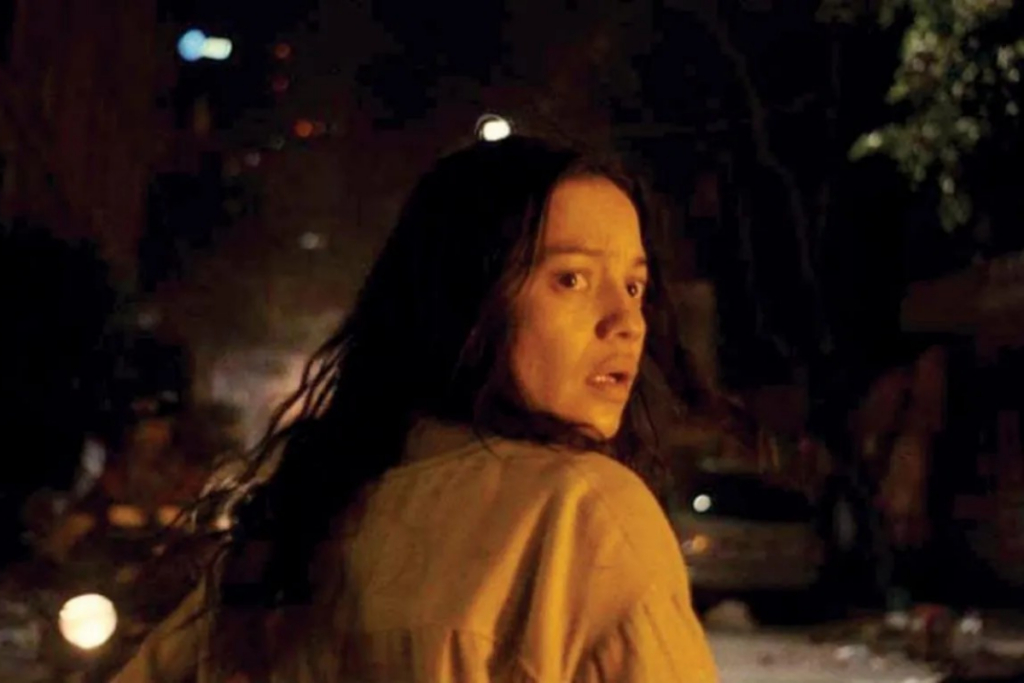

Aun es de noche en Caracas is inspired by the 2017 events in Venezuela and Karina Sainz Borgo’s novel "La hija de la española"

The Story: Adelaida and the Collapse of a Nation

The plot follows Adelaida Falcón, played by the talented Natalia Reyes, a woman who, after burying her mother in a crumbling Caracas, finds her home occupied by armed militiamen.

In a country where protests are violently suppressed and scarcity is the norm, Adelaida is forced to hide, assume a new identity, and navigate a maze of morally ambiguous decisions. Set during the 2017 protests, the film depicts not only the physical collapse of a city but also the emotional unraveling of those forced to become what they never imagined in order to survive.

Edgar Ramírez, who produced the film and plays a supporting role, has emphasized that “Aún es de Noche en Caracas” is not a political denunciation but an “artistic vehicle” aimed at humanizing the stories of those who have experienced dispossession, loss, and exile.

“It’s not a film about good and evil, but about victims who, in their desperation, sometimes become perpetrators,” the actor explained to EFE.

The Context: 25 Years of Crisis and Diaspora

The film arrives at a historic juncture: after 25 years of a regime that, according to Ramírez, became a “dictatorship”, Venezuela has seen four out of ten citizens leave the country in search of opportunities. “It’s the largest displacement crisis of the modern era,” the actor states, who himself experienced exile due to his political stance. Shot in Mexico with a predominantly Venezuelan cast in exile, the film reflects not only individual tragedy but also the collective loss of a country, an identity, and a future.

Directors Rondón and Ugás have underscored that “every intimate story is political,” and in “Aún es de Noche en Caracas,” this is evident. The film not only portrays violence and repression but also the “humanization of all characters,” even those who might seem like mere villains from the outside. “Everyone is a victim of a system that corrupts and pushes them to the limit,” the filmmakers explain.

The Power of Resistance: Art and Memory

“Aún es de Noche en Caracas” invites reflection of freedom, memory, and dignity. The film, presented at festivals such as Venice, Toronto, and Morelia, has been praised for its “unique perspective” and its ability to convey the “sense of a frozen time,” where night seems never to end.

The adaptation of Sainz Borgo’s novel, a literary phenomenon translated into over 20 languages, has been celebrated for its “poetry and rawness,” bringing to the screen a story that, while fictional, resonates with the reality of millions.

For Ramírez, the film is also an “act of cultural resistance,”said to EFE Agency. “Cinema has the power to keep memory alive, to remind us that in Venezuela there are no rights, that politics has been hijacked, and that ordinary people have had to choose between bad and worse,” says the actor, who sees the project as a way to “honor those who have lost everything but hope”.

The Impact: A Film for the World

“Aún es de Noche en Caracas” is about “loss, exile, and resistance”. The film has struck a chord with global audiences, especially at a time when migratory crises and authoritarian regimes are recurring themes.

The film, set to premiere in theaters in Mexico, Spain, Colombia, and Venezuela starting February 5, promises to be an intense cinematic experience designed to be seen on the big screen.

Photo IG @edgarramirez25

Q&A

RELATED POSTS

Receive the latest news

Subscribe To Our Magazine

Luster Magazine

Digital Magazine

Ingresa los siguientes datos y comienza a disfrutar de nuestra revista digital.