Explore Ruth Asawa’s full-career retrospective at MoMA, rethinking modern art with wire sculpture, public works, pedagogy, and a new institutional canon.
Por: Angela Leon Cervera
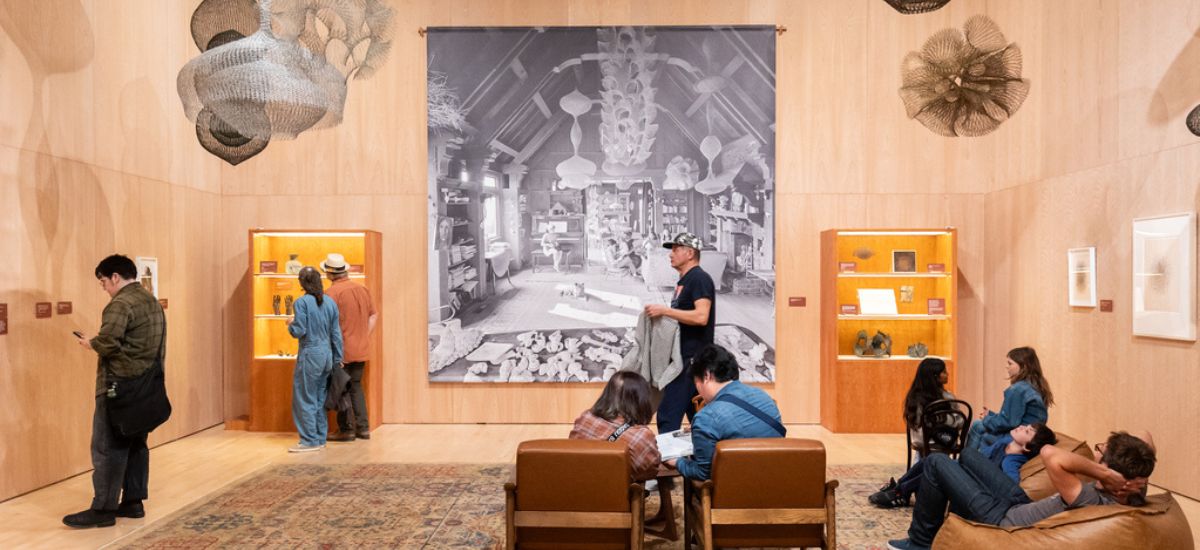
Ruth Asawa retrospective. Courtesy of SFMoMA
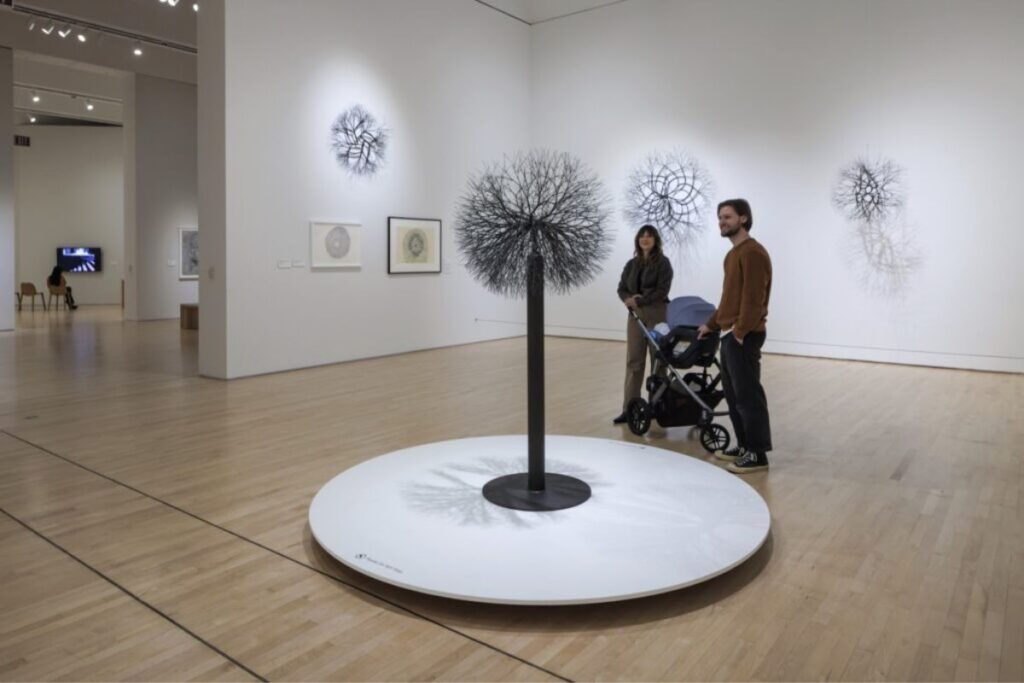
The forthcoming Ruth Asawa retrospective at MoMA marks a decisive moment in how museums recalibrate the canon of postwar modernism. Anchored in more than six decades of creative practice, the show promises a sweeping presentation that situates Asawa not merely as a maker of ethereal wire forms but as a central architect of modern abstraction.
This is not a modest tribute. Opening October 19, 2025, and running through February 7, 2026, the exhibition features some 300 works spanning sculpture, prints, drawings, bronze, archival material, and public commissions. At stake is nothing less than how institutions rewrite the narrative of American art to center voices historically marginalized.
Ruth Asawa retrospective. Courtesy of SFMoMA
Why This Retrospective Matters Institutionally
MoMA’s decision to host Asawa’s largest posthumous survey casts a powerful curatorial signal. The show will live on Floor 6 in the Steven and Alexandra Cohen Center for Special Exhibitions, a space reserved for marquee exhibitions.
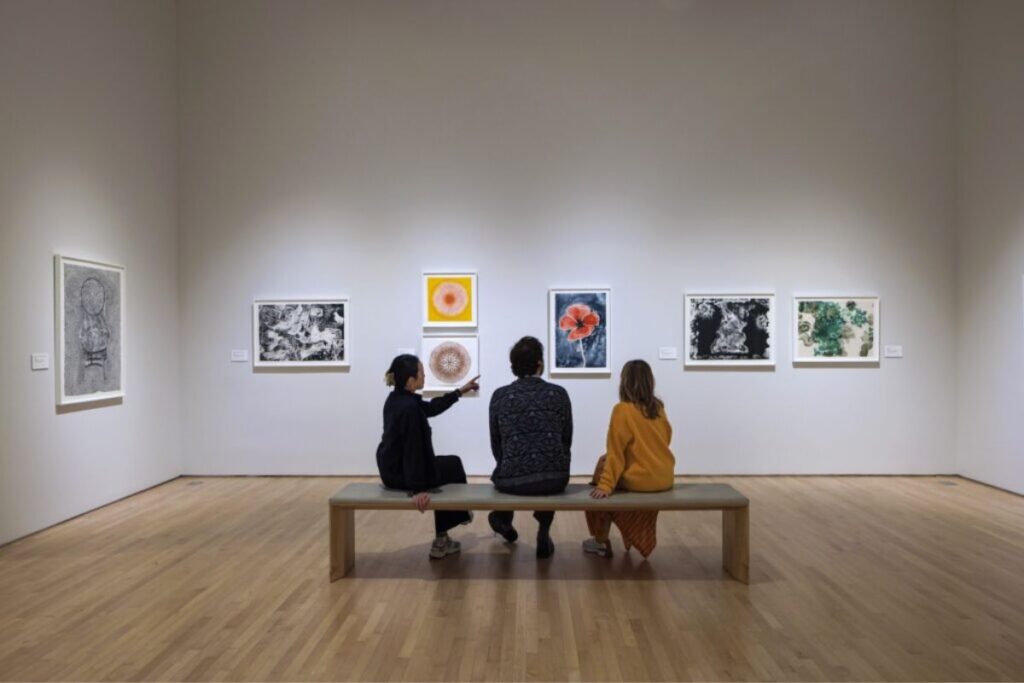
Featuring approximately 300 works, the retrospective aims to undo reductive views of Asawa as primarily a wire sculptor, expanding her recognition across mediums and public arts practice. It is part of a traveling circuit, following the version at SFMOMA (April–September 2025), and it continues to Bilbao’s Guggenheim and Fondation Beyeler afterward.
By placing Asawa at institutional center stage, MoMA and its partner institutions concretely correct long-standing absences in museum histories of abstraction and sculpture.
How the Material Poetics of Wire Reframe Abstraction
At the heart of Asawa’s art is wire, yet her use of it belies simple categorization. She treated wire as a line in space, weaving volumes that are simultaneously present and transparent.
The Sculpture as Drawing in Space
Rather than solid mass, Asawa’s looped forms create airy, skeletal volumes. She insisted that her sculptures operate like “drawings in space,” where form is defined by void as much as by line. Her tied-wire and looped structures allow light and air to pass, threading the boundary between object and atmosphere.
Shadow as Integral Partner
Asawa recognized the shadow cast by her sculptures not as mere byproduct but as essential counterpart. The negative silhouette becomes an echo of form, a spatial doubling that completes the work.
Material Innovation as Subversion
Her formal experiments extend beyond technique. In her later work she submerged copper wire forms in chemical baths to provoke textures reminiscent of coral or bark. This reversal of industrial shiny finish into rugged, organic patina speaks to her subversive dialogue within material systems.
The Confluence of Biographical Depth and Public Vision
Asawa’s life and and her public commitments are inseparable from her art. Her biography inflected the poetics of form, while her public vision allowed abstraction to operate in civic life.
Internment, Resilience, & the Roots of Weaving
Born in 1926 in Norwalk, California, Asawa and her family of Japanese descent were forcibly relocated during World War II. In internment camps, she made camouflage nets, a seed of her later weaving practice. This early entanglement of constraint, craft, and survival shaped her belief in art as material resistance.
Black Mountain College & Radical Pedagogy
After the war, Asawa attended Black Mountain College (1946–1949), encountering teachers like Josef Albers, Anni Albers, Buckminster Fuller, and Merce Cunningham. The interdisciplinary ethos of that milieu informed her practice across sculpture, drawing, design, and community engagement.
Domesticity, Motherhood & Spatial Metaphors
Raising six children while living and working in her Noe Valley home, Asawa’s studio life was not separate from everyday life. Her looped sculptures evoke containment and circulation, spatial metaphors that resonate with ideas of womb, home, and generative process.
Public Projects & Arts Advocacy
Asawa translated her aesthetic of openness into public works: fountains, memorials, murals, commissions across the Bay Area. She also championed arts education, cofounding San Francisco’s public arts school and launching community projects involving children and families
Ruth Asawa retrospective. Courtesy of SFMoMA
The MoMA Ruth Asawa retrospective is more than a museum round-up of beautiful objects. It is a recalibration of what counts as modernism, a bold institutional claim for art wrought from humility, from biography, from the weave of public and private life. In offering space to Asawa’s full practice, the retrospective updates the canon: we see wire, but also paper, shadow, texture; we see personal history, and civic imagination as an extension of abstraction.
This show asks us to reconsider: can the line that extends through space also carry memory, identity, care, continuity? Asawa’s answer resounds in every floating loop.
FAQ: What Readers Often Ask
How many works are in the MoMA retrospective? Approximately 300 works spanning sculpture, prints, drawings, bronzes, and archival materials.
When and where is the show? October 19, 2025 through February 7, 2026 at MoMA’s Floor 6 in New York
Did this retrospective start elsewhere? Yes, it debuted at SFMOMA (April 5 to September 2, 2025), then travels to MoMA and later to Bilbao and Basel
What is unique about Asawa’s technique? She used woven wire to create sculptural forms that function like drawings in space—transparent, light, and interpenetrable with air and shadow
Why is this retrospective significant now? It marks a curatorial shift: institutions are correcting historic exclusions by centering artists whose work bridges craft, domesticity, public engagement, and abstraction. It asserts a broader, more inclusive history of modern art.